
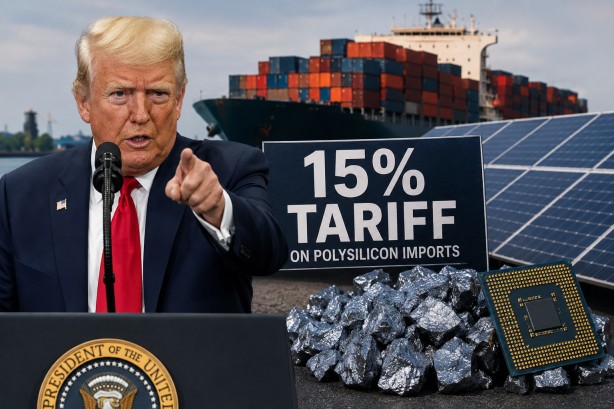
In an effort to boost domestic production and lessen dependency on China, President Donald Trump has announced a 15% tariff on imported goods made with polysilicon, a crucial material for both semiconductor and solar panel manufacturing. This tariff, set to be implemented on December 4, is part of a broader strategy to fortify critical supply chains that are essential to the United States’ economic and national security.
Polysilicon, an extremely pure form of silicon, is essential in the creation of semiconductors that are integral to artificial intelligence systems and data centers. It is also used in the production of solar cells and panels. Currently, China stands as the leading global producer of this vital material. The new tariffs will establish minimum import prices, including $21 per kilogram for polysilicon, $100 per kilogram for polysilicon ingots and wafers, $0.22 per watt for solar cells, and $0.38 per watt for solar modules and panels.
The U.S. administration asserts that these measures are designed to enhance the financial viability of domestic polysilicon production facilities. This move is also positioned as a safeguard for significant supply chains that have implications for both economic stability and national security. To encourage investment, the policy includes provisions that allow the government to create incentives for companies that invest in domestic polysilicon and related manufacturing facilities.
China has expressed discontent with the tariff decision, accusing the U.S. of exploiting national security arguments to unfairly restrict Chinese businesses. They warn that such protectionist actions could lead to disruptions in trade between the two countries. Despite these tensions, China’s export market continues to flourish, particularly in high-value sectors such as electronics and products related to artificial intelligence.
Currently, the United States hosts two primary polysilicon production facilities: Hemlock Semiconductor in Michigan and Wacker Chemie in Tennessee. The decision to impose tariffs reflects an ongoing effort to nurture and expand the domestic production landscape amidst global economic challenges and shifting trade dynamics.